By downloading the SD versions of the WWDC videos, you can have a complete set to watch much sooner than if you download the HD versions. Also, you have a much better chance of fitting the entire collection on your iDevice if you use the SD versions.
(This year Apple took only four days to make the videos available to all registered developers, which is really amazing. Thank you, Ron Okamoto!)
If you follow the link above you get to the HD versions of the videos in iTunes. That's a huge amount to download. If you click the "Developer on iTunes" breadcrumb on the upper right, you can get to the SD versions.
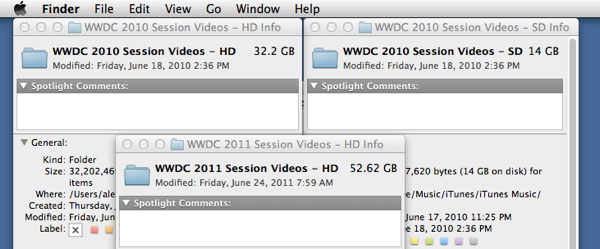
How much less are the SD videos to download than the HD ones? Doing a Get Info in Finder, I see that in 2010 the HD videos were about 32GB total, compared to 14GB for SD. Big difference, especially if your Internet access is not super-fast.
In 2011 Apple must have increased the resolution of the HD videos, because they totaled about 53GB. I assume the SD was again roughly half that, which would mean an even bigger size difference than in 2010.
iTunes says there are only 210 SD tracks for WWDC 2012, compared to 224 HD ones. ("Tracks" seems to include the PDFs of the slides, so really it's about 110 videos.) I don't know what's missing on the SD side.
In any case, I plan to download both sets, starting with SD so I'll have a complete set that much sooner. I do want the HD versions because they are noticeably nicer to watch. I seem to recall code samples sometimes being hard to read in the SD versions.
Got up early on Monday and walked over to Moscone with Lee (whom I'm sharing a hotel room with) and Howard (who's staying at the same hotel). Got on line for the keynote at 6:15 AM. We were joined by a few friends. Made it into the main room.
Keynote at 10:00 AM. Tim, Phil, Craig, and Scott did a great job. They transitioned smoothly, they were entertaining, they showed great stuff, they were all stars in their own ways. There was no ghost of Steve, and it felt appropriate to me that he was not mentioned. We've moved beyond that.
The demos were brisk and to-the-point. I have to say, sometimes Steve would linger a bit longer on a particular feature than I thought necessary.
I didn't lust for the Retina MacBook as I would have a year or two ago. As often happens, that may change when I get a chance to try one out in the store. I definitely can't justify getting one, though. My hardware needs are already well met, and then some.
I really enjoyed meeting up with friends.
In the evening, went with Lee to a NeXTSTEP retrospective hosted by Michael Johnson. It was a fundraiser for the Cartoon Art Museum. An amazing night. No time for details now.
Today I came across a blog post by Dan Nguyen, entitled "Feynman's Clock", that defends Richard Feynman from the stereotype of a genius scientist who is all brains and no feelings. I enjoyed the piece, but I have problems with it because it simultaneously perpetuates that very stereotype.
Nguyen talks about how Feynman reacted to the illness and death of his wife Arlene. Here's a quote from James Gleick's biography of Feynman (I assume the emphasis is Nguyen's):
Finally he heard a last small breath, and a nurse came and said that Arline was dead. He leaned over to kiss her and made a mental note of the surprising scent of her hair, surprising because it was the same as always.
The nurse recorded the time of death, 9:21 P.M. He discovered, oddly, that the clock had halted at that moment—just the sort of mystical phenomenon that appealed to unscientific people.
Then an explanation occurred to him. He knew the clock was fragile, because he had repaired it several times, and he decided that the nurse must have stopped it by picking it up to check the time in the dim light.
Seems reasonable to me. Here's Nguyen's commentary on that anecdote:
At a moment when just about anybody would shove aside rational thought – even at least as a helpless reaction to mindnumbing grief – and favor that the universe’s chaos stopped just then to offer a sign of divine significance, Feynman instead sticks to cold hard logic, even if it means sterilizing the moment of his wife’s death.
I disagree that the only natural reaction to grief is to "shove aside rational thought" and assume "divine significance" behind events that we would otherwise assume are coincidence.
I strongly disagree that Feynman "sterilized" the moment of Arlene's death, as if his use of reason devalued his emotions. Here's Feynman himself demolishing a related idea — the idea that scientific knowledge diminishes the perception of beauty:
You can see a beautiful thing and know some of the science behind it. You can grieve for your wife and figure out a non-magical explanation for why a clock stopped.
Bad enough that Nguyen plays into the very stereotype he later tries to counter — that being scientific is an emotionally crippling "unavoidable feature". Even worse is the blog post that Nguyen links to, entitled "A Deathbed Story I Would Never Tell", in which Robert Krulwich judges Feynman's thought processes to be so unseemly he wouldn't be caught dead admitting them himself:
What [Feynman] did was, he remembered that the clock had been fragile. He had been asked to fuss with it; he'd fixed it several times. In his memoirs (that is, in his version of this story), he says the nurse must have picked up the clock to determine the time of death, unsettled the workings inside, and the clock stopped. No miracle. Just an ordinary, accidental jostle. Here he is, describing a moment of enormous significance, and he won't allow a Signifier.
I couldn't do that. I would want to, almost need to, imagine a higher audience for a moment like that.
I have a real problem with the suggestion that it's pathological not to invent a magical Signifier, with a capital S, when a moment's thought comes up with a non-miraculous explanation that makes more sense. Meanwhile, the compulsive need to "imagine a higher audience" somehow indicates a more normal person?
Don't get me wrong. I understand the impulse to "imagine", and I can see how it's natural for some people, and a good impulse for, say, a fiction writer. I like to imagine things myself from time to time. What I don't get is assuming that that impulse maps to a higher reality.
Getting back to Nguyen — I do appreciate what he's getting at, and I recommend reading his entire post. He is absolutely right that if you think Feynman was "asocial" and "cold-hearted", you should read Surely You're Joking and What Do You Care to find out how wrong you are. Hell, you should read those books anyway because they're fascinating and funny. I just think Nguyen defeats his own purpose somewhat.