Spock using a spatial UI

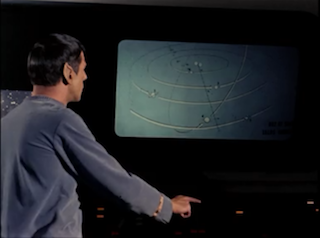
I was watching the very first Star Trek pilot, and I noticed that for one brief second Spock seems to use a spatial UI gesture to control the big screen.

If you have streaming Netflix, you can see for yourself right now. Perhaps you can check whether I'm mistaken. The episode is called "The Cage", and the moment I'm talking about is at 2:29. It looks like Spock swipes his finger in the air from left to right, causing the screen to change from a view of space to a map of some planets. He then says "Records show the Talos group has never been explored."

I learned from Wikipedia that although this episode was completed in 1965, it wasn't broadcast until 1988. Even with the 23-year delay, I wonder if it was the first example on TV of a spatial gesture-based UI, long predating "Minority Report" and the Kinect. Maybe not; I haven't watched all that much science fiction.

I'd like to see someone try to use this as a prior art argument in a patent lawsuit, as was done with the tablets in "2001: A Space Odyssey".
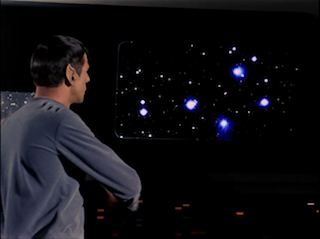
Spock gesture begin

Spock gesture end

Ellen and Bill

I think O'Reilly's arguing on the right side for the wrong reasons. People most certainly can and should protest a business if they feel it is doing something wrong.

The real issue is not whether it's wrong to protest a "business decision". The real issue is whether being gay has anything to do with morality in the first place. The people who are calling for Ellen to be fired believe it does, and the real answer is that that is wrong, not that business decisions are somehow exempt from protest.

He might be playing a little misdirection game here. Notice how he compares this to calls for him to be fired. (For me, Glenn Beck and Pat Buchanan came to mind.) He claims those are also wrong. I think he wants to be able to shoot down any attacks on him by saying "Hey, I defended the liberal side when it came to a gay person. Aren't you being just as bad as OneMillionMoms?"

I'll give O'Reilly more credit the day he stops calling homosexuality a "lifestyle", which is code for "It has moral implications."

I did enjoy his mocking the OneMillionMoms for declining to appear on the show. And the fact remains that he is defending Ellen Degeneres, for which she's rightly thanked him.

See also "Ellen Addresses Her JCPenney Critics".

[EDIT: Switched the second and third paragraphs.]

"Winning" personality does not mean what some people think it means

A Facebook friend linked to this article by Tom McNichol:

With the death and canonization of Steve Jobs and the emergence of the Jobs biography as a kind of sacred text for managers, the ranks of bosses who see Bad Steve's nastier traits as something to imitate is liable to swell.

Of the many, many documented things Jobs did while bringing Apple to where it is today, are there really managers out there picking the worst parts of his personality and deciding that's what to emulate? Or for that matter using Isaacson's bio as a "sacred text"? I haven't seen or heard of this management trend, but I haven't been around a lot of managers lately.

It's been pointed out that most of Apple's historic turnaround, including the iPod, iPhone, and iPad, happened while Jobs was sick. So I guess managers who want to emulate him should try to get cancer. You know, like those jazz musicians who thought if they shot heroin they'd play like Charlie Parker.

Speaking of drugs, Jobs supposedly said that Bill Gates would have been better off if he'd tried LSD in his youth. Why aren't managers following that advice? Or are they?

It's certainly possible there is a correlation between unpleasant personality traits and people who rise to the top in business. Let's just say such a correlation is not entirely implausible. That does not mean that by going out of your way to hurt people's feelings you will become a more successful manager or executive.

Here's Guy Kawasaki on the things he learned from Steve Jobs:

Notice that "be a jerk" is not on the list, which Guy has also written up in various places including Google+.

By the way, Guy gave an excellent version of this talk at MacTech Conference. MacTech will be making it available for free — soon, I hope.

Uncle Al

My Uncle Al passed away peacefully at 11:15 Friday morning. His dear friend Karen was with him.

When I was a small child Uncle Al taught me to climb stairs foot-over-foot instead of stopping with both feet on each step. This was at the old house in Ossining.

One day he showed me how the three angles of any triangle add up to 180 degrees, by cutting corners from a piece of paper. Without being pushy, he always encouraged me to learn.

When I was in high school he got me a summer job programming the Apple II. If you know me, you know how that turned out.

We celebrated Uncle Al's 88th birthday in October with a gathering at his favorite restaurant in Chinatown.

Whenever I see something on the Web about Chinese food or history, my first reflex is to email it to Uncle Al. It will take a while for that reflex to fade. I will miss Uncle Al's infectious laugh and the running gag between us where he'd tease me about my endless appetite. I will always admire the devotion with which he cared for Aunt Kay in her final years.

I invite family and friends to share remembrances in the comments section below. If you'd like to share a photo you can email it to me at aglee@earthlink.net, and I will add it to this post along with any comment you would like to add.

For the moment

Apparently the common on-stage mistakes that public speakers make — and I definitely made some — were the least of my worries.

There has been excellent food for thought on all sides.

I never intended to make anyone feel excluded or belittled. What I hoped was to entertain and inform.

For the moment at least, that is all I have to say.